
The Story
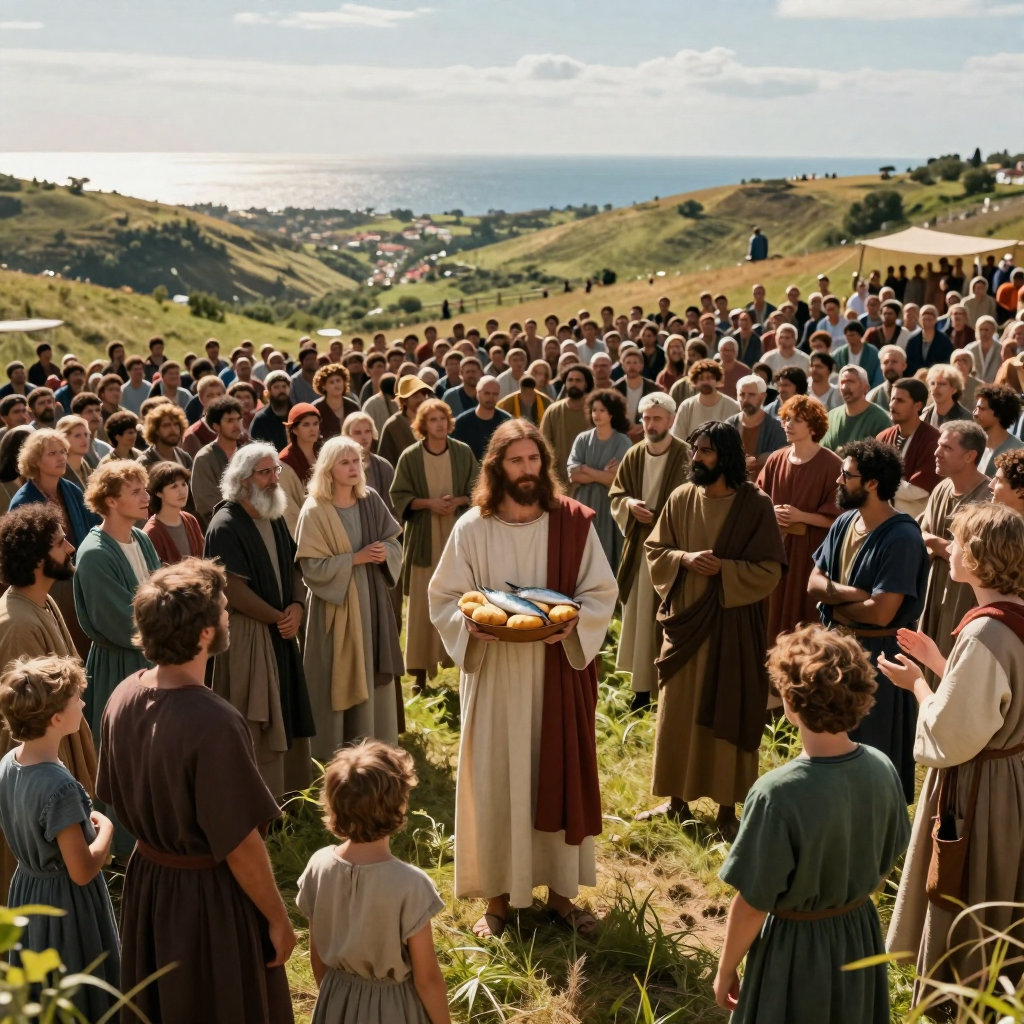
At first glance, this seems like a simple miracle that Jesus performs in front of tens of thousands of people. The basic story says that Jesus is teaching a crowd of disciples and followers. His closest disciples notice that the crowd is hungry after listening to Him. In the story of the 5,000, it is noticed that a young boy has 5 loaves of bread and two fish. Clearly this wouldn’t be enough to feed everyone, and Jesus tells them to gather baskets and then performs a miracle. Somehow the baskets were full of bread and fish so that everyone could satisfy their hunger.
This story can be used in so many scenarios and services to relay many messages.
One could teach –
With little, God can provide a lot.
If we put our faith in Jesus, he will provide.
We need to be filled both physically, but more importantly spiritually.
One thing is very clear with the feeding of the 5,000. It was a very significant story to the Jewish writers of the gospels. How do we know this? All four writers of the good news found it so important that they all included it in their testimonies. Yes, each book has this story in it. (Matthew 14:13-21, Mark 6:30-44, Luke 9:10-17, and John 6:1-15) Clearly there must be a deeper message here versus a simple miracle of Jesus multiplying food for everyone to eat.
I can’t stress enough how essential it is to step out of a literal story to explore God. This is a huge story to understanding the purpose of Jesus, but you’ll miss it if you only pay attention to the literal storyline.
Let’s explore this story deeper –
The Background:
We’ll start with the obvious. I did say tens of thousands of people and am well aware of the fact that 5,000 plus 4,000 totals 9,000 people. Let’s get this out of the way. In those days, women and children wouldn’t have been counted. Only the men were counted, since the assumption is that they were the only ones who were allowed to be taught and were educated. The assumption can be made that it’s assumed only 9,000 people understood the message Jesus gave. This also was a practice going back to Numbers 1, where men were counted only who were of military age. Hence, this is partly why this story is told to show that Jesus could have started his own army at these points. This becomes a pivotal moment in his ministry when he shows the real meaning of why he came. It was not to overthrow Rome, but rather to prove there is a greater kingdom if you put full faith in God.
But wait a minute! The story shows a miracle where Jesus fed thousands. How does that connect to putting faith in God? Let’s look at the fine details that you may have glossed over. In John’s account of the story, right at the beginning, he mentions Passover is near. Even though John doesn’t get into a ton of details in his book, John is amazing at pointing out the most important parts of the story. This mention of Passover is huge. The dilemma becomes – There isn’t enough food. How will they be fed? One suggestion is if we had enough money, we could buy food. However, we can’t overlook this VERY essential detail that John puts out there. Passover is near. Have you ever tried shopping at a store right before a major event? Holy day (holiday)? Many of us have possibly run into a grocery store right before or early on Thanksgiving. Maybe we remembered we forgot to get a certain person something the day before Christmas. What was that experience like? Many times the store was out of what we were looking for or needed. Today we have computers and databases, and many of these stores can predict how much they need to have even for last-minute shoppers, and yet they always seem to be out of things.
Stop for a moment and put yourself in the shoes of Jewish communities two millennia ago. There were no refrigerators. There were no computers and historical data to analyze. On top of that, Passover lasts an entire week. No work was to be done on the first and seventh day of Passover. It was also a huge celebration. Even if one wanted to work, they would have planned and prepared to not do much work during this time. Working to make food was allowed on the other days, but selling or buying food wouldn’t have taken place.
Does the dilemma seem clearer now that we note the very important detail John left for us? Even if they had enough money, they most likely couldn’t have bought enough food. The places to buy food wouldn’t have stocked up prior to Passover, since all the food would have gone to waste. Even more, God always frowns on wasting food. At the end of the story, Jesus instructs his disciple to get all the leftover food so it doesn’t go to waste. By the way, in those days, bread larger than the size of an olive was considered waste. Anything smaller could have been fed to the dogs. Now with that little information, go back and read the story of the Canaanite woman again.
Aha! Now I get it. Put faith in God, and he will provide! Thank you. Story done. I understand it better!
But wait! There’s more!
The Real Story:
This story is FAR deeper than just Jesus starting his ministry and wanting to feed people at the end, realizing there wasn’t enough food on hand and they couldn’t buy enough even if they needed to. Forget the fact that 200 denarii was half a year’s wages and still not enough money. You’re missing the biggest detail of all if that’s what you’ve heard or know of this miracle. Who is there in the field listening to Jesus? Who is the writer of these testimonies in the New Testament? Again, why did every Gospel writer see this as a significant story? John’s in particular focused on Jesus’s highlight moments. He admits to it at the end of the book.
Let’s go deeper. The audience is Jewish people in the feeding of the 5,000 and maybe some gentile who were curious about what was happening. The audience is there to try to figure out if they are simply in the midst of another prophet or the Messiah, as the rumors suggest he is. Clearly this guy seems to be working with God, but to what extent? To understand this, we need to step back and ask questions that we should already know the answers to and that they would have understood. Who provided bread in the past? Let me ask that again. Who supplied bread in the past?
Let me step aside for a second to interject another point here. Where was Jesus born? We are taught it was in the town of Bethlehem. Joseph and Mary must travel there to be a part of the census, and Jesus is born there. Have you ever explored the meaning of the name of the city? In Hebrew, when we see “Beth,” it means house. So when we see a word like “Bethel” (in English), “El” is shorthand for Elohim, or god. So Beth-El means House of God. The city of Beth-lehem follows the same pattern. I separated the letters to help. We now know that “beth” means house. What about Lehem? Ready for this? “Lehem” means bread or food.
Whoa. So you’re saying it wasn’t an accident that someone born in the house of bread provides bread? No. So I ask again, WHO provides bread in the Old Testament? Or should I use the word “manna”? Now we’re getting somewhere. God provides bread. God provides food. God brings food from out of nowhere. God provides even when it seems impossible to do so! Go back and reread the story of Moses in the wilderness.
This is more than just a miracle. This is more than an act. This is GOD in front of them, and a crowd of Jewish people would have immediately understood this. The faithful would have understood the magnitude of this event.
Questions:
You want even more? Which story follows this? Jesus walks on water.
Who tames and controls the waters? Go back to the beginning. Genesis 1. Even better, stick with the Moses story line. Who tames the water there, too? If you say Moses, I would say go back and read it again. Moses does NOT part the sea. Moses follows God’s directions, and God parts (controls) the waters. Moses simply followed orders, but God performed the miracle.
So what about Jesus providing the fish? What is the significance of the fish? Meditate on this. The feeding of the 4,000 was gentiles. The next story after the 5,000 is Jesus controlling the waters. Has it ever occurred to you that these stories would have struck down everything the Romans and Greeks, who heard about Jesus, knew about their faiths and beliefs?
Have you ever explored how Jesus multiplying fish and later controlling the waters strikes down any common belief in those days that Poseidon and Neptune were the only “gods” that controlled the seas? Was Jesus there for more than just the Jewish people in attendance?
Was Jesus proving he was relevant to more than just the Jewish people, but also the entire world as they knew it?