
The Story
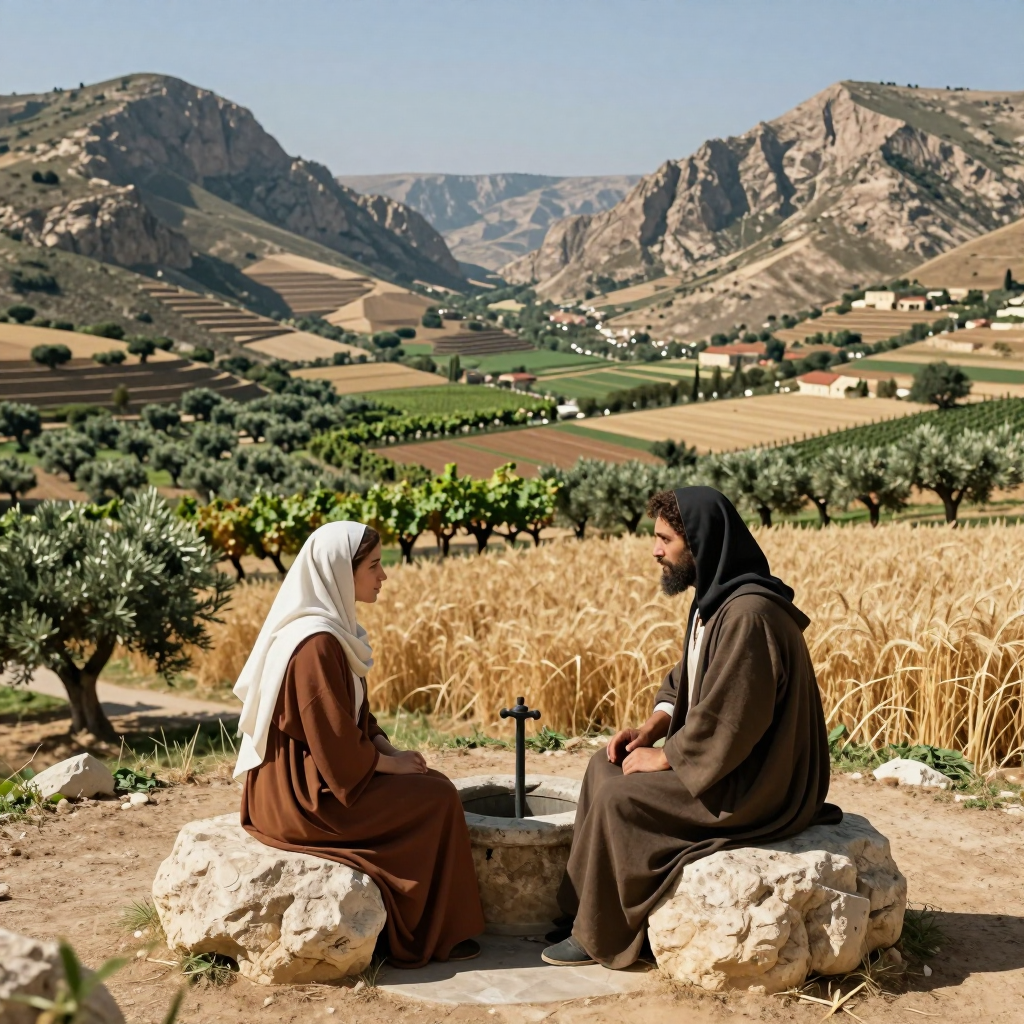
Upon reading John Chapter 4, we read about a very interesting encounter orchestrated by our teacher. What appears to be a story of circumstance is anything but
We are told of a story where Jesus sends his disciples into town to grab something to eat. In the meantime, Jesus makes his way over to a well, where he “runs into” a woman. During this encounter, Jesus asks the woman for water. This woman is very troubled for many reasons. She travels to the well during the middle of the day. This is the hot time of day when most women would not go to the well. Typically, women would go in the earlier time of day since it would be cooler. However, this is no ordinary woman. She goes to the well to be by herself for a reason. We find out why through Jesus’ conversation.
.
Jesus tells the woman to call her husband, and she replies to him that she doesn’t have one. Jesus now points out that she is correct. Not only does he point out she has had five husbands, but also that she is now living with a man who isn’t her husband at all.
This woman recognizes that he is possibly a prophet at this point. She then points out a belief to Jesus, the belief of her “people”. She points out that her people use to worship on a mountain (read below for more details) however she points out the HE says that Jerusalem is the place to worship. Let’s say that again. She says HE says it is in Jerusalem; that is where worship is required. We need to revisit this again below.
Now Jesus then explains to her something every Jewish person has been waiting many generations to hear. He proceeds to explain to her that the hour is coming that no one will need to worship on that mount or in Jerusalem. This website will have failed if these words Jesus speaks in John 4:21-24 are not clear. Jesus tells her that salvation came through the Jewish people. However, things are about to change. In the past, the Jewish people worshiped a God they’ve never seen. However, everyone will now worship something they know. Essentially, what Jesus is telling her is the traditions and covenant will soon be fulfilled (or filled full) through him (see Matthew 5 – The Sermon on the Mount). Keep reading because we need to get deep starting here.
The Background:
As is every story in the Gospels that involves Jesus, there is a much deeper meaning happening here. Where is this encounter happening? We’re told it happens at a well near Sychar in the region of Samaria. So what we have here isn’t just some woman at the well but rather a Samaritan woman. If we know the history of Samaria, we know they are treated very badly by “true” Jewish chosen people. Samaritans were once Jewish people. However, we learn in the Old Testament that they started having children with non-Jewish nations. Based on the teaching of purity taught in the Torah, these were considered impure acts. In as easy a description as I can make, what happens is a division in Jewish culture. There is essentially a north and south division (split).
The journey the disciples take is already uncomfortable for them since they knew exactly where they were heading. They knew the implications of impurity surrounding them by even traveling to this region, much less talking to someone. Even more, Jesus, a rabbi, a teacher, is talking to a woman in public. Hold on a minute, this is huge. Even more, of all the people in town to talk to, he’s talking to a woman with a past. Not only is she a Samaritan, but she’s also an outcast in her own culture. She’s had five husbands and is living with another man who isn’t her husband. What is Jesus thinking?
And what about this well? They aren’t just at any well, and Jesus isn’t just asking for water from just any well in the area. The location is at Jacob’s Well. What is known as a living well. A well where fresh and new water is always flowing versus a stale well. But wait, we need to address this further. Jesus mentioned there will be an hour when you won’t need to worship at that mountain or in Jerusalem, and this makes it clear to the woman that Jesus is more than a prophet. That split that I mentioned previously also led to a split in beliefs. The Northern Jewish people believed that the Messiah would go to that specific mountain where Jacob’s well was near, which is why it became a place of worship. Likewise, the Southern Jewish people believed the Messiah would arrive in the temple in Jerusalem.
The Real Story:
The woman at the well story embodies much more than just an encounter at a well with the Messiah. We find out that the woman figures out who Jesus is. She runs into town and tells everyone what she knows and, more importantly, what He knew about her. Basically, this woman becomes the first minister in his now-starting public ministry. Her public testimony will now lead people to see if what she says is true, since, in those days, men wouldn’t have believed a story from a woman. Even more, a woman with a “reputation”. It will lead people to Jesus and, in turn, see proof of the “invisible” God that they had been worshiping for generations in the physical state of a human. Jesus tells her that the physical water she drinks isn’t enough, but rather that the living water he can provide will nourish her for eternity.
If you go back to the first scroll of Kings (1st Kings) at verse 18, you start to get a deeper backstory of where the split occurs between Northern Israel and Southern Judea. This story gets every deeper when we realize that the Northern Samaritans worship on the Mount of Gerizim because of a reference in Deuteronomy 27 and verse 4 that was changed in the Samaritan version of the Pentateuch. The text in the South says the temple will be built on Mount Ebal.
Jesus had a far deeper mission of establishing the name of the Father amongst the lost and later new followers. Jesus didn’t come to get in the middle of the various differences in the beliefs of the Northern and Southern regions. He did correct many things in his time here and point us in the direction we should be following, but his time to judge has not come yet. God has always simply wanted you to put all faith and trust in him. He knows humans won’t get it completely right. We only have the Bible to read to understand that. However, he has always looked at the heart as the true test of faith. We still live in a world where no one truly knows if there is a denomination or church that is 100% right in their practices towards worshiping God. I can assure you that I have yet to find one. The Bible tells us in various places that we should always meditate on scripture and seek the truth through God and the works of Jesus, versus relying on man to tell us who God really is.
Questions:
Why does Jesus start his public ministry not only with a woman, not only with a well-known sinner, but also in a land and region not considered by some to be “pure”?
Since we know Jesus ultimately ends up in Jerusalem and takes down the temple “in three days”, what are we to gather from the fact that he starts his ministry in the other place? It was believed by the Northern Jewish people to be the place the Messiah would arrive at. Is Jesus picking a side, or is that even relevant to his work and purpose? On a personal note, in many of Jesus’ stories man thought they knew what he was expected to do and they were flat out wrong. This is what I love about the testimonies. Put all your trust in God and God alone.
Are we meant to look even deeper than this surface-level story teaches us? Jesus spends a lot of time explaining to the Pharisees and Sadducees that their teachings are not accurate. Is this encounter another example of that? We later learn the temple was not a physical place on Earth. Should we stop and meditate on this story even more?
What do we make of Jesus finding a sinner to spread the news of his ministry versus a “pure” heart?